Chapter 15: Complex Tokens as Ration Cards
Complex tokens differed from plain tokens in every important way.
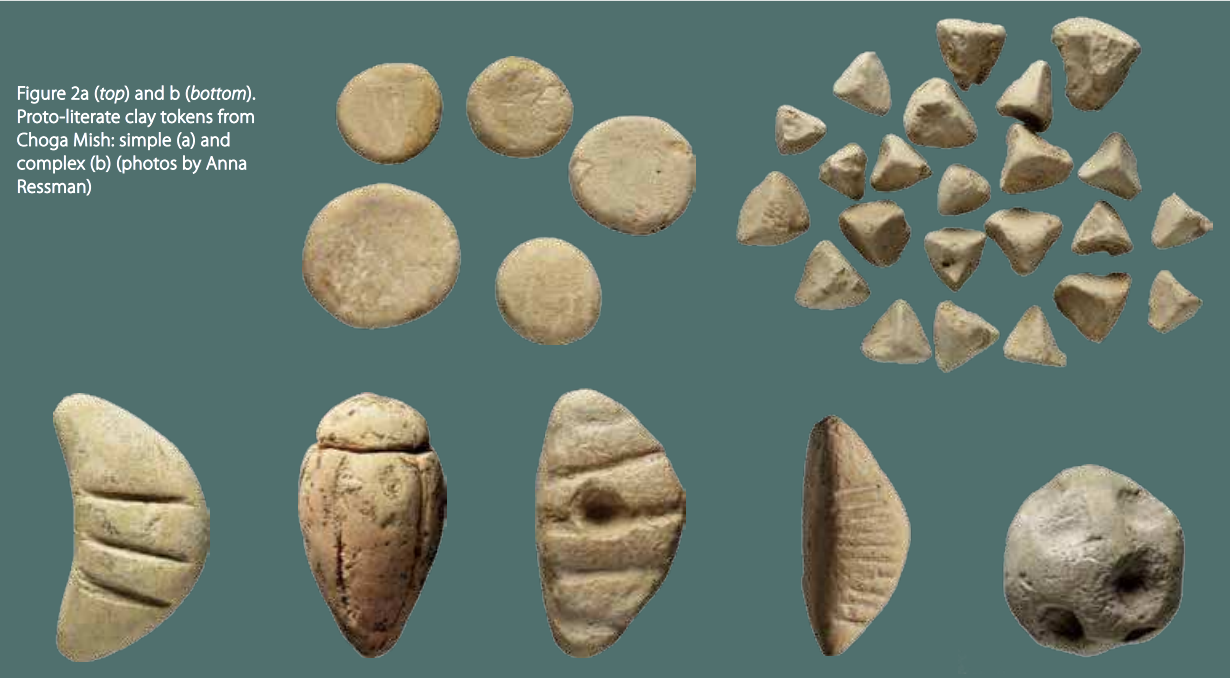
Comparison of plain tokens (simple geometric shapes) and complex tokens (elaborate forms with pictographic markings).
Pictographic Markings
Plain tokens were simple shapes. Complex tokens bore markings:
"In some cases the design may be indicative of the commodity represented, for example, pitting shown at the mouth of some vessels may suggest the foam of beer or the cream of milk."
—p. 15
Beer foam. Milk cream. Specific commodities.
This specificity makes sense for ration cards. A token showing beer foam means "entitled to beer ration." A token showing textile pattern means "entitled to cloth."
Money does not need pictures of beer. Ration cards do.
Limited Distribution
"The complex token assemblages had a limited geographic distribution. They did not occur in Turkey or Palestine but were confined mostly to southern Mesopotamia."
—p. 50
Complex tokens appeared only where temple bureaucracies existed.
Money spreads through trade. Ration cards spread through political control.
Temple Locations
"At Uruk the majority of the tokens was excavated in the precinct of Eanna."
—p. 93
88.1% from the temple precinct. Not from houses. Not from markets. From the temple.
Temples administered rations. Ration cards would concentrate there.
Beveled-Rim Bowls
Complex tokens consistently appear with beveled-rim bowls:
"beveled-rim bowls, the latter being recovered by the hundreds"
—p. 33
These bowls were standardized in size—about 0.6 to 0.8 liters. Crudely made. Mass-produced.
Archaeologists interpret them as ration vessels. Standard portions in standard containers.
The association is telling. Complex tokens authorized rations. Bowls delivered them.
Short Duration
Complex tokens flourished for only a few centuries—roughly 3500 to 3100 BC.
Then writing replaced them.
This brief duration contrasts sharply with plain tokens, which remained unchanged for five thousand years.
Currency is stable. Administrative systems evolve under bureaucratic pressure.