Research & Inventions
Quantum-safe protocols, distributed systems, and the future of secure infrastructure
Patents & Key Inventions
RAIDA — Redundant Array of Independent Detection Agents
U.S. Patent #10,650,375
A distributed authentication architecture that is an alternative to blockchain. Multiple independent detection agents across different jurisdictions verify data authenticity through consensus. No single point of failure. Operational since 2016 without breach or downtime.
- 56,000 transactions per second
- Sub-millisecond latency
- Quantum-safe by design
- No blockchain, no mining, no public ledger
- Cannot be brought down by governments, hackers, or nuclear weapons
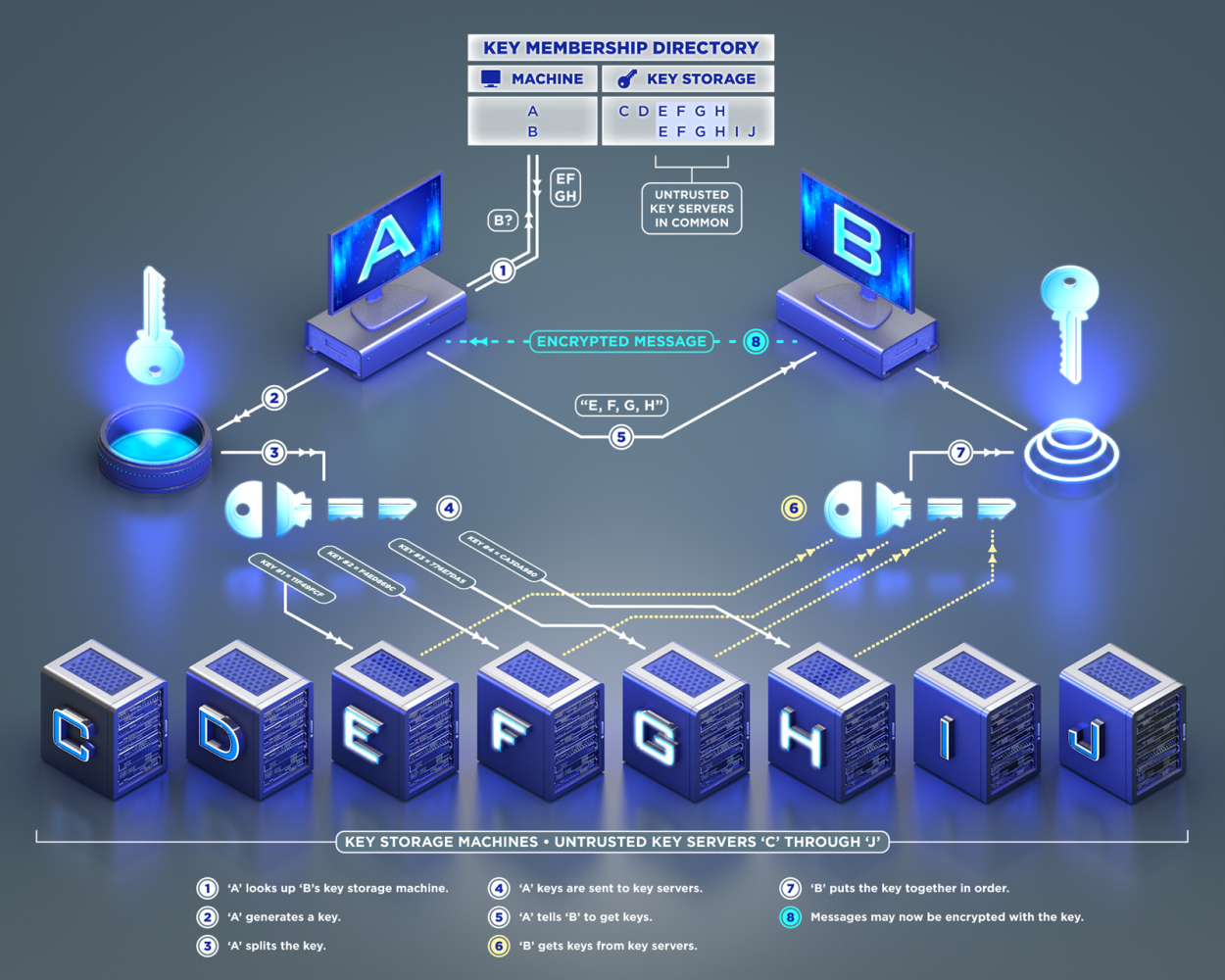
Distributed Key Exchange (DKE)
Patent Pending
A quantum-safe key exchange protocol that uses standard AES encryption instead of computationally expensive lattice-based cryptography (ML-KEM). Enables quantum-resistant security on resource-constrained IoT devices.
- 20-30x less computational overhead than ML-KEM
- Leverages existing AES hardware acceleration in 99% of devices
- Lower power consumption — critical for battery-powered IoT
- Mature, trusted cryptography (AES) vs newer lattice-based systems
Distributed Mail Exchange System
A novel email protocol that dramatically reduces computing resources needed for messaging.
- Includes CBDF (Compact Binary Document Format) — reduces document formatting size to 2%
- Distributed authentication to stop spam
- Quantum-safe data storage
- Reduces email server operating costs by 80%
CloudCoin
A digital currency implementing the Theory of Perfect Money. The world's only true digital cash system — cannot be counterfeited, double-spent, mined, or lost. 100% private with no public ledgers, accounts, or encryption required.
Technology Visuals




Origin Story
Operation Raleigh (1985)
At age 16, Sean competed at Stanford University against 39 candidates (ages 16-23) in a grueling 3-day survival competition organized by Prince Charles. After being the only competitor to start a fire using only sticks and stones, he won a spot on an international scientific expedition to unvisited areas of the Australian Outback, conducting vegetation surveys.
U.S. Air Force (1986–1992)
Served 6 years as an aircraft crew chief, leading teams of mechanics on complex jet engine systems. Earned an A.S. in Aviation Maintenance, FAA Airframe & Powerplant license, and the rank of Staff Sergeant. This experience instilled the principle of “Fix it Twice” — once to get it working, once so it never breaks again — and a deep understanding of redundancy in safety-critical systems.