Chapter 5: Geography—Too Widespread for Coordination
The geographic distribution of tokens undermines the commodity-counter theory.
The Extent of Token Distribution
Tokens have been recovered from over 115 archaeological sites spanning:
- The Levant (Israel, Palestine, Lebanon, Syria)
- Anatolia (Turkey)
- Upper Mesopotamia (northern Iraq, northeastern Syria)
- Lower Mesopotamia (southern Iraq)
- Susiana (southwestern Iran)
- The Iranian plateau
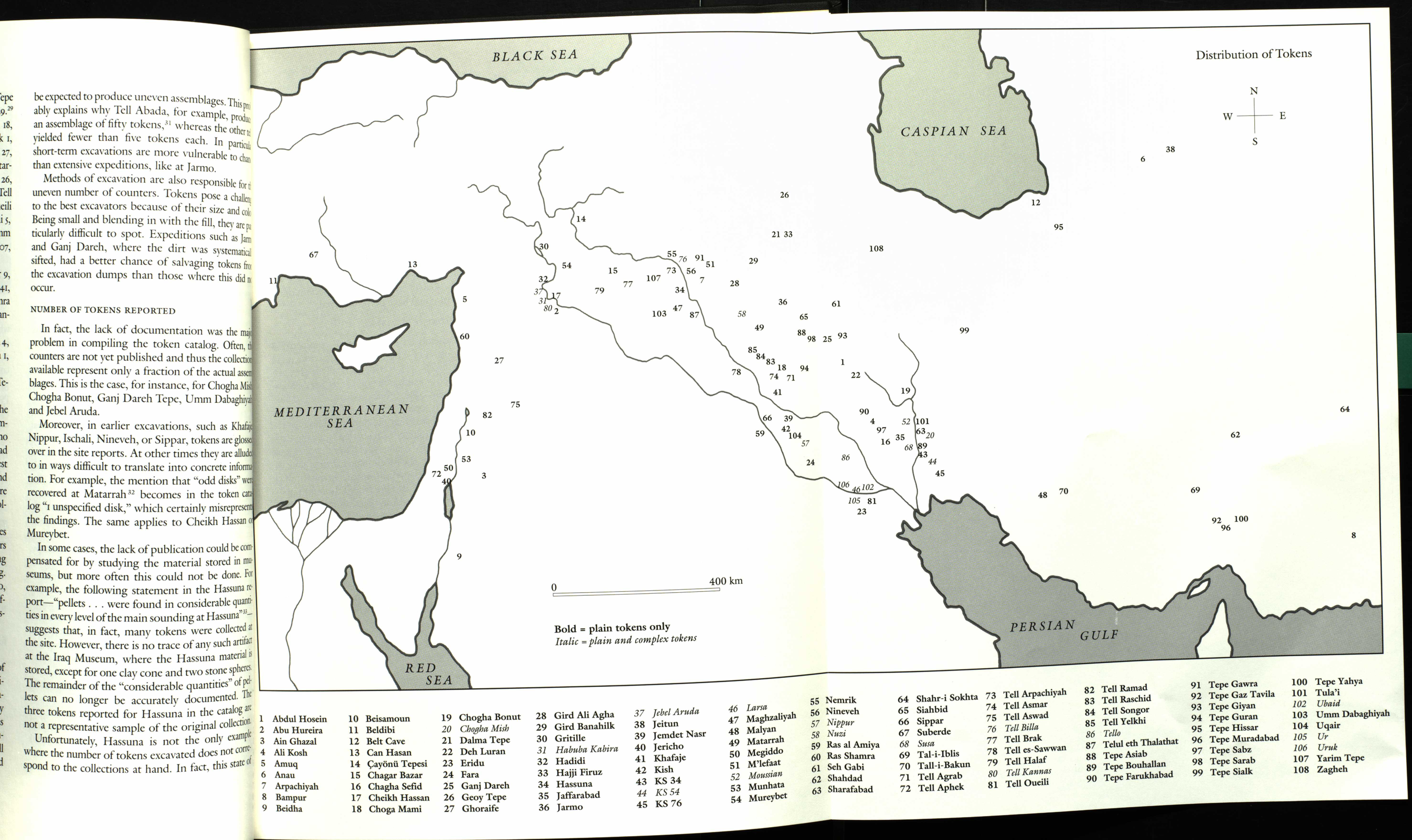
Archaeological sites across the Near East where clay tokens have been discovered.
This territory spans nearly two thousand miles from west to east.
It encompasses:
- Mediterranean coastal climates
- Arid deserts
- Mountain highlands
- River valley floodplains
- Steppe grasslands
The economies were completely different. Coastal communities fished. Highland communities herded. Valley communities farmed. Steppe communities combined herding with cultivation.
Yet the same token shapes appear everywhere.
The Coordination Problem
How could isolated communities across thousands of miles agree on meanings?
If cones meant "grain," what about communities without grain agriculture?
Consider Ganj Dareh, a site in the Zagros mountains dating to 7500-6500 BC. This community raised goats. There is limited evidence of grain. Yet they had cones.
Were they trading with grain communities? Perhaps. But then the cone does not mean "grain" to them. It means "something I can trade for goats."
Its meaning becomes abstract—a unit of value, not a specific commodity.
The Money Solution
Money resolves this puzzle instantly.
Money does not need to represent specific commodities. Money represents value itself. A dollar works for buying fish, grain, or pottery.
Different communities using the same money naturally converge through trade. If community A and community B both use tokens, trade flows smoothly. Tokens that facilitate trade spread. Others die out.
This is spontaneous coordination, not centralized planning. It requires no authority to standardize meanings. It requires only trade.
Statistical Evidence
"There is no apparent distinction, for example, between the token assemblages of sites which produced stamp seals... and those that did not."
—Schmandt-Besserat, p. 26
This observation is devastating to the commodity-counter theory.
Stamp seals indicate administrative complexity. Sites with seals have bureaucracies. Sites without seals do not.
If tokens were accounting devices, sites with more administration should have different token assemblages. More complex economies should require more complex tokens.
Instead, the assemblages are identical. Sites with and without administration use the same tokens the same way.
This makes sense for money. Money does not require administration. A farmer can use money without scribes or bureaucrats.
Contrast with Complex Tokens
Complex tokens show the opposite pattern.
"The complex token assemblages had a limited geographic distribution. They did not occur in Turkey or Palestine but were confined mostly to southern Mesopotamia."
—Schmandt-Besserat, p. 50
Complex tokens appeared only where temple bureaucracies existed. They spread from Uruk to connected sites, not through trade networks.
This is what institutional systems look like. They spread through political control, not voluntary exchange.
Plain tokens spread through trade. Complex tokens spread through bureaucracy.