Chapter 1: The Mystery of the Clay Tokens
Ten thousand years ago, humans invented money.
This was not the money you know. No gold coins. No paper bills. No digital wallets. This first money was made from mud.
Small clay objects. Fired in primitive kilns. Shaped into simple geometric forms: cones, spheres, disks, cylinders, tetrahedrons. About the size of your thumbnail. Anyone could make them. And everyone did.
Archaeologists have found these objects at over 115 sites. They span from Israel to Iran. From Turkey to the Persian Gulf. They appear in the archaeological record around 8000 BC—six thousand years before the pyramids.
For decades, scholars dismissed these objects as "counters." Primitive accounting devices. A cone meant "one bushel of grain." A sphere meant "one jar of oil." Scribes supposedly used them to track inventory.
This interpretation is wrong.
These clay objects were money. The world's first currency. And understanding what they actually were—what they actually did—changes everything we think we know about the origins of civilization.
You Heard It Here First
What follows is my original interpretation. No one else has looked at the physical evidence this way.
I am not an archaeologist. I have a background in computer information systems. When I looked at these clay shapes, I did not see primitive counting devices.
I saw data.
I saw authentication tokens.
I saw the same technology I invented for a digital currency called CloudCoin—United States Patent #10,650,375.
The Mesopotamians beat me to it by ten thousand years.
What Are Clay Tokens?
Before we go further, let me describe exactly what we're talking about.
Physical Description:
Clay tokens are small, solid geometric objects. Most are one to three centimeters in size—roughly the size of a marble or gumball. They were made from clay, often fired in kilns to create a hard ceramic.
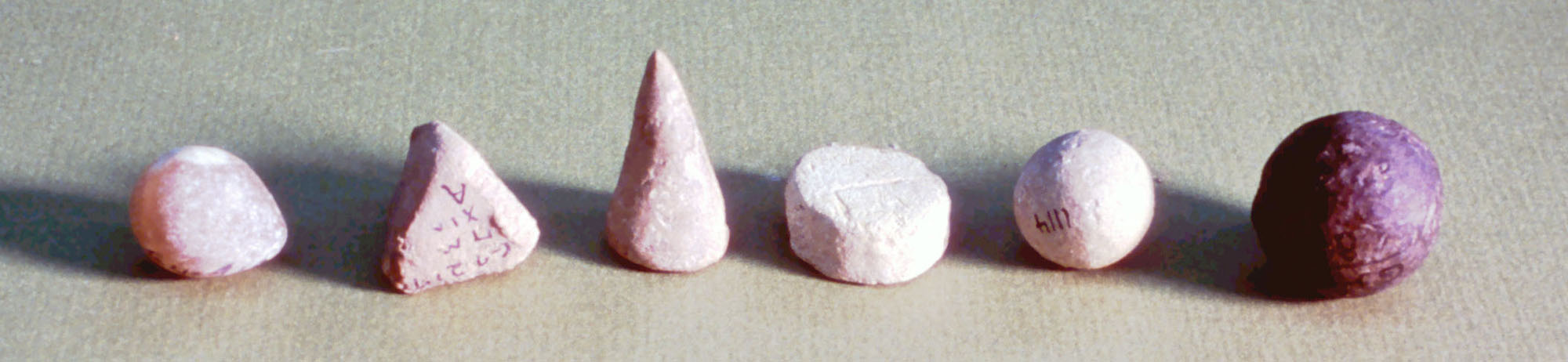
Clay tokens showing basic geometric forms: cones, spheres, disks, and other shapes.
The shapes are basic geometry:
- Cones (like traffic cones or ice cream cones)
- Spheres (balls)
- Disks (flat circles, like poker chips)
- Cylinders (tubes)
- Tetrahedrons (four-sided pyramids)
- Ovoids (egg-shaped)
Some have markings: incised lines, punched dots, or patterns. Others are completely plain. The plain ones are older. The marked ones came later.
Key insight: These were the first clay objects ever made. Pottery came later. Tokens came before bowls, before pots, before ceramic vessels of any kind.
"When tokens were invented, they were great novelties. They were the first clay objects of the Near East and the first to be fired into ceramic. Their shapes also were revolutionary since, as Cyril Smith has pointed out, they first exploited, systematically, all the basic geometric forms."
—Schmandt-Besserat, Before Writing, p. 17
Where Were They Found?
Tokens have been recovered from archaeological sites across the entire Near East:
- Storage rooms and warehouses
- Doorways and gatehouses
- Domestic houses
- Hearths and fireplaces
- Burials and graves
- Inside hollow clay balls (called "bullae")
"The data available on the structures associated with tokens indicate that the 'counters' were often located in storage facilities and warehouses."
—Schmandt-Besserat, p. 97
The locations tell us something important. Tokens were not just found in archives or administrative buildings. They were everywhere people lived and worked.
How Many Exist?
Thousands.
"The catalog of seven thousand tokens has been compiled by studying the collections in the museums where they were stored."
—Schmandt-Besserat, p. 31
And that's just what survived ten thousand years and happened to be excavated.
Why I Call Them "Cryptomorphs"
Archaeologists call these objects "tokens" or "counters"—terms that assume an accounting function. I reject that assumption.
I call them cryptomorphs.
The word comes from Greek: kryptos (hidden) + morphe (form, shape). Hidden shapes.
Why "hidden"? Because these objects were concealed inside hollow clay balls called bullae. The shapes were secret—known only to the owner and the authenticator. They were the world's first encrypted data.
Why "shapes"? Because the shapes themselves were the data. Not symbols representing something else. Not pictures of grain or oil. Just geometric forms: cones, spheres, disks. The specific combination of shapes in your collection was your unique identifier—your password, your key, your proof of ownership.
A cryptomorph is self-representing data. A cone represents a cone. A sphere represents a sphere. The combination "three cones, two spheres, one disk" does not mean "three bushels of grain plus two jars of oil plus one textile." It means "three cones, two spheres, one disk"—a unique pattern that authenticates you.
This is not a metaphor. This is literally how modern authentication works. Your password does not "mean" anything. It is just a pattern that matches a stored pattern. The match proves you are you.
The Mesopotamians invented this ten thousand years ago. They hid random combinations of shapes inside clay balls. They kept matching copies. They used the match to authenticate ownership.
Cryptomorphs. Hidden shapes. The first encryption. The first authentication. The first money.
The Conventional Theory: Commodity Counters
The standard interpretation goes like this:
Ancient farmers needed to track their goods. One cone meant one bushel of grain. One ovoid meant one jar of oil. One sphere meant one large measure. Scribes used these tokens as counting devices.
Later, tokens were sealed inside clay envelopes. The shapes were impressed on the outside. These impressions eventually became cuneiform writing.
This is the story taught in universities. It appears in textbooks. It forms the foundation of how we understand the origins of writing and record-keeping.
There is only one problem.
The evidence does not support it.
Recent Scholarship Challenges the Conventional Theory
Before examining specific problems, note that recent academic research has begun to question the commodity-counter interpretation.
In 2020, Lucy Bennison-Chapman published a systematic analysis of over 700 clay objects from Catalhoyuk—one of the most thoroughly excavated Neolithic sites. Her conclusion was striking:
"Systematic analysis of over 700 clay objects, considering object form, use-wear, immediate contextual deposition and broader spatial and temporal patterning, finds no support for the interpretation of these items as information storage tools at Catalhoyuk."
—Bennison-Chapman, "Conscious Tokens" (2020), p. 107
She found no standardization, no correlation with commodities, and no evidence tokens were used in groups for record-keeping. Most were found as isolated objects in trash middens.
Similarly, a 2014 study of Neo-Assyrian tokens by MacGinnis and colleagues concluded:
"It is not at present possible to establish the meaning associated with each token type."
—MacGinnis et al., "Artefacts of Cognition" (2014), p. 300
If tokens represented specific commodities, archaeologists should have determined those meanings by now. They have not.
Five Problems With the Conventional Theory
Problem 1: Not Enough Shapes
There are only about sixteen basic token types. Yet Neolithic economies involved dozens of commodities:
- Multiple grains (wheat, barley, emmer, millet)
- Multiple animals (sheep, goats, cattle, pigs, donkeys)
- Animal products (milk, cheese, wool, leather, horn)
- Fish and shellfish
- Tools and textiles
- Labor and services
Sixteen shapes cannot represent dozens of commodities. The math does not work.
Problem 2: Same Shapes Everywhere
The same token shapes appear across thousands of miles. From the Mediterranean coast to the Iranian highlands. In fishing villages and farming communities. In regions with completely different economies.
How could isolated communities independently agree that "cone equals grain" when some communities did not even grow grain?
Problem 3: No Correlation With Products
If cones represented grain, sites with more grain agriculture should have more cones. They don't.
"There is no apparent distinction, for example, between the token assemblages of sites which produced stamp seals... and those that did not."
—Schmandt-Besserat, p. 26
Statistical analysis shows no relationship between token types and local products.
Problem 4: The Timing Gap
Plain tokens appear around 8000 BC. Cuneiform writing emerges around 3100 BC. That is a gap of nearly five thousand years.
If tokens were proto-writing—if they represented commodities symbolically—why did writing take fifty centuries to develop? The representational leap had supposedly already been made.
Problem 5: What Were They Counting?
Tokens predate pottery, permanent architecture, and granaries. They are the very first clay artifacts.
If tokens were for counting stored goods, what were they counting? The infrastructure for storing goods did not exist yet.
A New Interpretation: Authenticity Tokens
Here is what I believe these objects actually were.
The clay shapes were data. Not symbols that represented something else. Just data. Pure information encoded in physical form.
This data was self-symbolizing. A cone symbolized a cone. A sphere symbolized a sphere. The shapes did not mean "grain" or "oil." They meant themselves.
"It is not at present possible to establish the meaning associated with each token type."
—MacGinnis et al., "Artifacts of Cognition"
These were authenticity tokens. They were used for authentication—to prove identity and authorize access. The random combination of shapes in a collection served as a shared secret between two parties.
This is not a metaphor. This is not an analogy. This is literally what I built in CloudCoin. The Mesopotamians invented the same technology ten thousand years ago.
The Lock and Key System
Here is how I believe the system worked.
Imagine you are a farmer in 8000 BC. You have grown more grain than you can eat. You need somewhere safe to store it—safe from thieves, pests, floods, and fire.
The answer: a temple granary. A secure building managed by priests. Built from their newest technology: bricks.
But there is a problem. The priest cannot remember which farmer owns which grain. There is no writing. No numbers. No symbols for names or accounts. If the priest forgets who owns what, the farmer loses access to his grain.
What they needed was authentication. A way to prove ownership without writing.
The solution was shared secrets.
Creating the Lock:
The priest takes a clay bowl. He fills it with sand. He hides a random collection of tokens under the sand—say, three cones, two spheres, and one disk.
This bowl becomes the lock. It is placed just inside the doorway of the storage room.
Creating the Key:
The priest creates an identical collection of tokens—three cones, two spheres, one disk—and puts them in a leather pouch.
This pouch becomes the key. It is given to the farmer.
Authentication:
When the farmer wants to access his grain, he brings his key to the priest. The priest compares the contents of the farmer's pouch to the contents of the bowl inside the storage room.
If they match, the farmer is authenticated. He can enter.
With this system, no one has to remember anything. There is no need for writing. The tokens themselves carry the authentication data.
"No impression of textiles has ever been recorded, either on tokens or on the floor where they were recovered. It is more likely, therefore, that leather was preferred to cloth for storing the clay counters."
—Schmandt-Besserat, p. 97
The Shapes Are Random
This is crucial to understand.
The shapes in a key were random combinations. They were not denominations. They were not categories. They were arbitrary patterns chosen specifically to be hard to guess.
Think about a modern combination lock. The combination 23-47-15 does not "mean" anything. It is just a random sequence that happens to open your particular lock.
The token combinations worked the same way. Three cones, two spheres, one disk. That pattern does not "mean" anything. It is just the shared secret that authenticates one particular farmer.
Security requires randomness. If everyone's key contained the same pattern, thieves could simply copy it. The random combination makes counterfeiting nearly impossible.
"Their distribution through the palace does not allow for any further conclusion as to their use or significance. All contexts in fact appear to be random, the tokens chance-finds."
—MacGinnis et al., "Artifacts of Cognition"
Archaeologists noticed the random distribution. They were puzzled by it. But randomness is exactly what you would expect from an authentication system.
From Locks to Money
The lock-and-key system solved the storage problem. But it also created something new: transferable value.
Consider what happens if the farmer wants to trade his grain rights to someone else.
He does not have to go to the temple. He does not have to involve the priest. He simply gives his key—the leather pouch—to the other person. Now that person can access the grain.
The key has become money.
It represents value (the grain in storage). It is transferable (just hand over the pouch). It is verifiable (compare it to the lock). It works without any central authority tracking the transfer.
How Long Did Money Circulate?
This is where I made an error in my first draft.
I said tokens were "single-use" and "discarded after transactions." That was wrong.
Here is the correct understanding:
Tokens circulated as long as people trusted them.
If I give you a leather pouch full of tokens, you accept it because you believe the tokens are authentic. You believe they will open a lock somewhere—or that someone else will accept them in trade.
As long as that trust exists, the money keeps circulating. It can change hands dozens or hundreds of times without anyone needing to verify it.
When does verification happen?
Only when trust breaks down. Only when someone suspects the money is counterfeit. Then—and only then—do both parties go to a priest to have the money authenticated.
Better security = longer circulation
Later, the Mesopotamians invented bullae: hollow clay balls that enclosed tokens and were covered with seal impressions. These seals were difficult to counterfeit. They provided visible proof that the contents had not been tampered with.
With bullae, money could circulate even longer. The seal impressions gave receivers confidence. They did not need to break open the ball and verify the contents unless they had strong suspicions.
This is the same principle as modern security features on currency. Paper bills have watermarks and security threads not so you verify every bill, but so you can verify if you suspect counterfeiting. The security features extend trust and keep money circulating.
Counterfeit Detection
When suspicion arose, the system had a verification mechanism.
- The buyer and seller go together to a priest (the "system administrator")
- The priest breaks open the money (the bulla or examines the pouch)
- The priest compares the contents to his records (the "impressed tablet")
- If they match, the money is authentic
- The priest issues a new piece of money to the rightful owner
- This new money has a new random combination of tokens
The impressed tablet is a clay record showing what tokens were supposed to be inside a particular piece of money. This was a crucial innovation—a form of primitive writing created specifically for counterfeit detection.
"It is remarkable that each of the 17 impressed signs can be traced to a token prototype."
—Schmandt-Besserat, p. 133
The priests could not simply hand back the old tokens. If they did, both the original owner and any counterfeiters would know the combination. New tokens with new random patterns had to be issued.
This is exactly how CloudCoin works. When you authenticate a CloudCoin, the passwords change. The old passwords become invalid. Even if someone had copied your coin, their copy is now worthless.
The CloudCoin Parallel
I did not discover this theory through archaeology. I discovered it through building a digital currency.
CloudCoin stores data in files. Each file contains 25 "authenticity numbers"—random passwords registered with a distributed network of servers. Whoever knows the passwords owns the coin.
When you transfer a CloudCoin, the new owner can (but doesn't have to) change the passwords. Now only they know the new passwords. Even if the previous owner kept a copy, that copy is worthless.
The Mesopotamians did the same thing with clay and leather.
- CloudCoin file = leather pouch
- Authenticity numbers = token combinations
- RAIDA servers = priests with impressed tablets
- Password change = issuing new tokens after verification
Ten thousand years of technological progress, and we reinvented the same system.
Key insight: The parallel suggests these principles are not arbitrary. They reflect fundamental requirements for secure, transferable value.
The Rest of This Book
This is a radical reinterpretation of the archaeological evidence. It overturns decades of scholarly consensus.
I do not expect you to accept it without evidence.
The rest of this book will:
Part II examines the evidence supporting authenticity tokens as money: timeline, geography, findspots, the seal system, burials, and the gatehouse evidence.
Part III demolishes the commodity-counter theory: the symbol shortage, the flawed Oppenheim tablet, the backwards logic of accounting before money.
Part IV explains what happened around 3500 BC: the rise of temple states, the invention of ration cards (complex tokens), and the evolution into writing.
Part V explores implications: money enabled civilization, centralization corrupted the system, and modern currency design can learn from ancient wisdom.
Let us begin.