Chapter 8: Burials and Hearths—Treating Tokens as Wealth
How people treat objects reveals what those objects mean.
Clay tokens were treasured, ceremonially destroyed, and buried with the dead. This treatment is consistent with money. It is inconsistent with accounting records.
Tokens in Graves
From early in the token system, tokens appear as grave goods:
"Tepe Guran provides the first evidence of tokens used as funerary offerings in Iran. Namely, two tombs at the site were respectively provided with one clay sphere and one clay cone."
—p. 25
Burial practices reveal cultural values. People bury the dead with important items:
- Tools for the afterlife
- Treasures displaying status
- Offerings to gods
Why would anyone bury counting devices?
If tokens were mere accounting tools, burying them makes no sense. You might as well bury tally sticks.
But if tokens were money, burial is natural. Cultures around the world bury wealth with the dead. Egyptian pharaohs. Chinese emperors. Viking warriors.
The burial of tokens indicates they had value—not utility, but value.
Stone Tokens
Some tokens were made from fine stone rather than common clay.
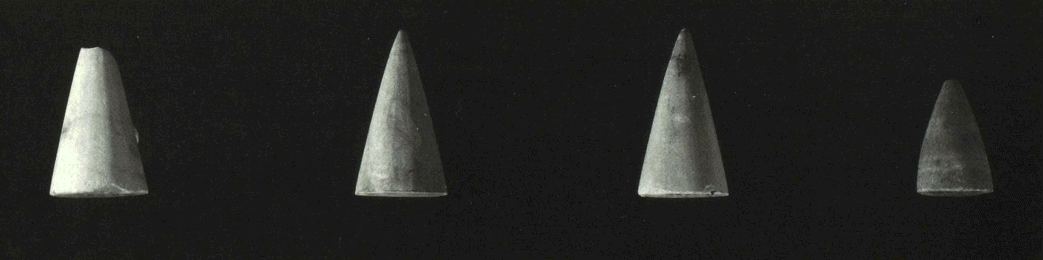
Stone tokens—laboriously crafted from fine materials rather than common clay.
"It is difficult to imagine why anyone would opt for the time-consuming and arduous task of grinding stone into tokens when they are so easily made of clay."
—p. 25
Schmandt-Besserat finds this puzzling. Why make stone tokens when clay is easier?
The answer lies in humanity's oldest preoccupation: the afterlife.
Humans have always believed in gods and life after death. And throughout history, people have tried to buy their way into heaven.
Consider the parallels. In medieval Europe, the Catholic Church sold indulgences—payments that supposedly reduced time in purgatory. The wealthy paid handsomely for spiritual insurance. The Church grew rich.
The Mesopotamians may have invented the same scheme five thousand years earlier.
Stone tokens could have been marketed by priests as afterlife authentication. Just as tokens authenticated a person at the gates of a city, palace, or storeroom, special tokens could authenticate you at the gates of heaven.
Picture the sales pitch: "When you die, your spirit will be stopped at the gates of the underworld. The gatekeepers will demand proof that you paid your dues on Earth. These sacred stone tokens—blessed by the temple, recorded in the divine ledgers—will prove your worthiness. Without them, you will be turned away."
This would have been enormously profitable for temples. And the more exclusive the tokens, the more valuable they became. Only the wealthy could afford the premium stone versions. Clay tokens might get you into a granary. Stone tokens would get you into paradise.
This interpretation explains:
- Why stone tokens required laborious grinding when clay was easier
- Why they appear specifically in burials
- Why wealthy individuals possessed them
- Why temples would encourage the practice
The authentication system that worked for earthly transactions was extended into the spiritual realm. Gates are gates—whether guarding a storehouse or the afterlife. The cryptomorph system worked for both.
Tokens in Hearths
Tokens have been found associated with hearths and fireplaces:
"It is puzzling that counters were located in fireplaces... One of these houses was still filled with long spouted jars that held a black, powdery substance."
—p. 97
Why would counting devices be in fireplaces?
The answer may lie in Mesopotamian beliefs about demons and the supernatural power of fire.
Demon Bowls and Portals
The Mesopotamians had a rich tradition of using objects to control demons. Later artifacts called "incantation bowls" or "demon bowls" were inscribed with spells and placed under thresholds and corners of homes to trap evil spirits. As one source describes: "When placed upside down under each corner of a house, demons would follow the inscribed charms that spiraled from the outer rim inward, only to be caught in the center."
This tradition of using physical objects to control supernatural forces likely extends back to the token period.
Bitumen: The Sacred Flammable Substance
The Mesopotamians had access to a remarkable natural resource: bitumen—a naturally occurring tar that seeps from the ground in places like Hit (ancient Id) in modern Iraq. Bitumen was considered sacred. The Akkadian word for bitumen, iddu, comes from the city name itself.
Mesopotamians believed the sounds emanating from bitumen deposits—gas escaping through crevices—were the voices of underworld gods. King Tukulti Ninurta II (890-884 BC) described Hit as "the place of the Usmeta stones, in which the gods speak."
Ritual texts from 1800 BC describe bitumen offerings to the goddess Ishtar, explicitly linking its flammable nature to purification rites.
Tokens as Demon Keys
Just as tokens could be sold as keys to heaven's gates, they could also be sold as keys to demon portals.
Imagine the product: clay tokens embedded in bitumen instead of enclosed in clay balls. A priest sells you a "spell"—a specific combination of cryptomorphs set in flammable tar. When burned in your hearth, the fire activates the portal. The cryptomorphs authenticate your request to the spirit world. Demons can be cast out. Blessings can be invited in.
This would explain tokens found in hearths. They were not accidentally dropped. They were deliberately burned as part of ritual practice.
The appeal would be universal. Everyone fears demons. Everyone wants protection. Everyone wants to feel control over the unseen forces affecting their lives. A priest offering authenticated demon-control spells would find endless customers.
And like afterlife tokens, exclusivity increases value. Common clay tokens might handle minor spirits. Rare stone tokens—requiring laborious grinding—might control more powerful entities.
Temple Revenue
This represents yet another revenue stream for temple authorities:
- Tokens for earthly authentication (granary access, trade)
- Tokens for afterlife authentication (heaven's gates)
- Tokens for supernatural authentication (demon control)
The same technology. The same production. Three different markets. The temples had invented a diversified product line.
No one ritually burns inventory records. But people absolutely burn offerings to control the spirit world.